
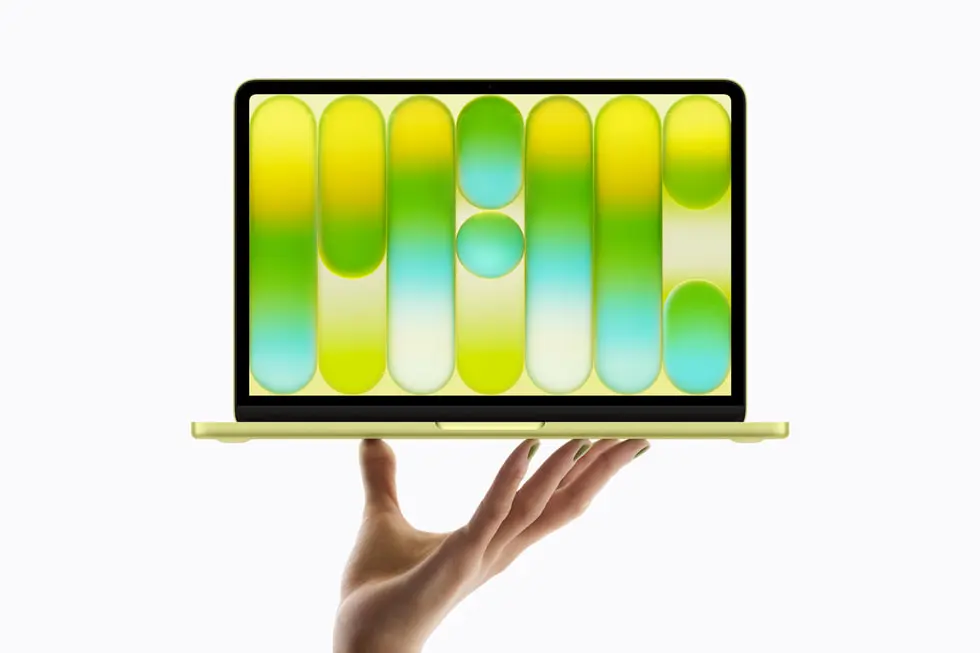

If you’re wondering how the new MacBook Neo performs—and, more importantly, whether its budget Mac pitch makes sense versus a similarly priced Windows laptop or even a Chromebook—the first benchmarks to surface help put things into perspective. The key is that the Neo introduces something highly unusual in the Mac lineup: an iPhone chip. Specifically, it uses the A18 Pro that debuted in the iPhone 16 Pro, though with an important graphics caveat that shows up in the results.
According to the published figures, the MacBook Neo scores 3,461 points in single-core and 8,668 points in multi-core, plus 31,286 points in Metal. What does that mean in real terms? Its per-core performance is surprisingly high for a machine aimed at everyday tasks, while multi-core performance lands closer to older Apple chips used in Macs—which fits the kind of user this model is targeting.
Apple, for its part, isn’t comparing it to other Macs, iPads, or iPhones in its official messaging, but to PCs in the same bracket. In its marketing, the company claims the A18 Pro is up to 50% faster in everyday tasks than the best-selling PC with an Intel Core Ultra 5 “in the latest version available,” and it also promises up to 3x performance for on-device AI workloads and up to double the performance in photo editing. It all sounds very keynote-like, but these early numbers help clarify the direction Apple is heading.

Benchmarks: where the Neo fits vs iPhone, iPad, and Mac
The most direct—and most logical—comparison is with the iPhone 16 Pro, since they share the same chip family. The phone scores 3,445 in single-core, 8,624 in multi-core, and 32,575 in Metal. In other words: the Neo is almost identical on CPU and a bit behind on GPU. That’s no accident, because the MacBook Neo has one fewer GPU core than the iPhone 16 Pro, so the dip in Metal is within expectations. Yes, it’s odd to see a laptop “losing” in graphics to a smartphone, but in this generation the difference comes down to chip configuration, not form factor.
If we compare it with a MacBook Air with M1, the Neo has a clear advantage in single-core: the M1 posts 2,346 in single-core and 8,342 in multi-core, with 33,148 in Metal. Put another way, the Neo improves responsiveness per core significantly versus the M1, while multi-core lands at a similar level. In graphics, the M1 still comes out slightly ahead in this specific Metal sample, though more factors are at play there and it’s best not to draw absolute conclusions from a single result.
The picture changes when the M4 MacBook Air enters the scene, with 3,696 in single-core, 14,730 in multi-core, and 54,630 in Metal. The jump in multi-core and GPU is massive, so it doesn’t make sense to expect the Neo to compete there. On the tablet side, the M3 iPad Air scores 3,048 (single-core), 11,678 (multi-core), and 44,395 (Metal), again ahead in multi-core and graphics power, while the iPad 11 comes in at 2,587, 6,036, and 19,395 respectively.
Looking at the overall picture, the Neo stands out in one very specific way: high single-core for its positioning, with multi-core that puts it closer to what an M1 laptop delivered. That fits the profile taking shape: a Mac built for day-to-day use, not sustained heavy workloads. In other words, the kind of machine that lets you open a thousand tabs “for work” and still pretend you’re not streaming a video in another window.
Which tasks the A18 Pro favors—and where it isn’t the best fit
In real-world use, single-core performance tends to show up in the things we do constantly: web browsing, document apps, email, video calls, or video playback. That’s why this figure matters more than it may seem: an affordable laptop is judged by how smooth it feels, how it responds when opening apps, and how snappy it is in everyday use. And here, at least based on benchmarks, the Neo looks set to feel very quick.

On the other hand, Apple’s messaging and the numbers suggest the MacBook Neo isn’t aimed at scenarios where multi-core rules: video editing, music production, 3D modeling, and similar tasks. It’s not that it can’t open those apps, but the goal isn’t to go head-to-head with Macs running M3 or M4 chips—neither in core count nor in graphics horsepower. If your routine involves renders, long exports, or heavy projects, the multi-core comparison with the M4 Air makes the gap obvious.
On-device AI is also relevant, since Apple claims up to 3x versus the best-selling PC with a Core Ultra 5 for these workloads. It’s best read as a positioning message: the Neo wants to be the “do-it-all” computer people now use for content consumption, studying, document work—and increasingly, running smart features locally. On Windows, for example, if you want to fine-tune startup or diagnose what’s loading in the background, here’s a guide to MSConfig in Windows 10 and 11. Will this be the typical laptop bought by people who just want everything to work without digging into specs? It certainly looks that way, although for now we’re looking at just one benchmark, so averages could shift once more units are out in the wild.
Price, availability, and what a “$599 Mac” really means
The MacBook Neo starts at €699 in Europe and $599 in the United States, is available for pre-order, and launches on March 11. That number alone reshapes the landscape: it’s a price that typically pushes you toward entry-level Windows laptops or Chromebooks, so Apple appears to be targeting that segment with a simple idea—offer a Mac for everyday use, with very competitive per-core CPU performance, and a performance narrative versus PCs in its class.
There’s one more detail that helps explain the context: the name “MacBook Neo” surfaced tied to a regulatory filing (model A3404) published on Apple’s website, without images or additional technical information. Those kinds of clues are usually boring… until they end up confirming the product exists and that the direction is real, not just calendar-driven rumors.
All in all, the most useful thing about these early data points is that they set expectations: the Neo isn’t going to compete with the more powerful MacBook Air models, but it could become the entry-level laptop many people have been waiting for—especially if your priority is everyday smoothness and not living in a render queue. And in a world where more and more devices share chip DNA across categories, seeing a Mac with an iPhone heart stops being a curiosity and starts looking like a very deliberate strategy.


