
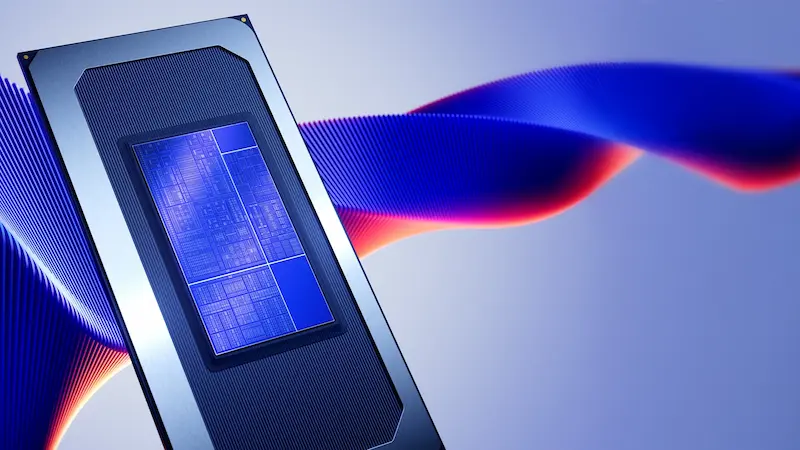

If you’ve been closely tracking the next wave of “AI PC” laptops, what you really want to know is this: what’s new in Intel Core Ultra Series 3 (Panther Lake), how they’re built, what they promise in performance, and what their NPU numbers mean for Copilot+ PC-style features. The key here isn’t a single isolated spec, but the combination of a chiplet-based design, the move to 18A, and a very up-to-date connectivity package.
Intel positions Panther Lake as an evolution of its modular approach: instead of one monolithic chip, it uses several pieces of silicon (tiles) assembled on a base using Foveros packaging. This method lets Intel mix and tune components to cover different segments, and also leverage different manufacturing processes where it makes sense in each part of the processor—something that, by 2026, is starting to feel almost standard across the industry, even if it remains a very serious technical puzzle.
Tile-based architecture and the role of Intel 18A
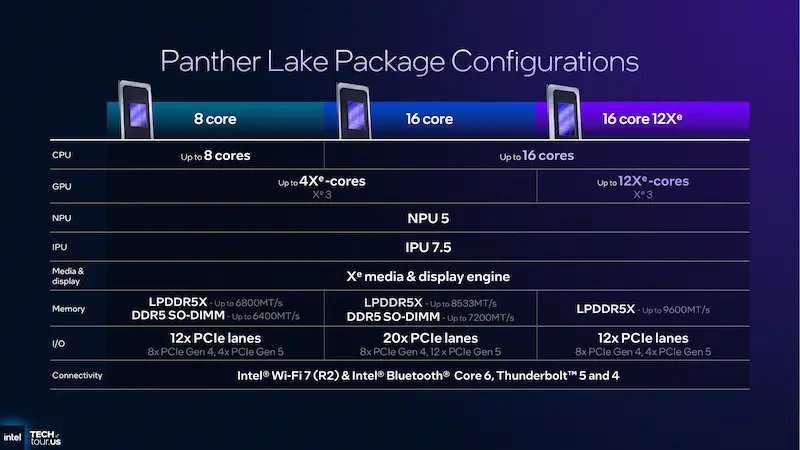
In Panther Lake, the chiplet approach takes shape as multiple specialized tiles mounted on a “base tile” using Foveros. The most significant one, in terms of manufacturing strategy, is the compute tile, which houses both the CPU cores and the NPU (neural processing unit). This is the tile Intel builds on its 18A process, and it comes in two variants: one with up to 16 CPU cores and another with up to 8 cores.
The rest of the chip isn’t 100% Intel-made. The platform controller tile, responsible for most of the I/O, is manufactured at TSMC, as is the high-end version of the graphics tile with 12 cores. And, in contrast, there’s a simpler graphics tile variant with 4 cores that Intel produces on an earlier process, Intel 3, which so far has been used primarily in server Xeon CPUs. It’s a striking mix: the newest and the most “proven” living in the same product, with the clear intent of optimizing costs, supply, and scalability.
This modular approach allows Intel to combine pieces like building blocks and offer three clear Panther Lake iterations: 16-core CPU + 12-core GPU, 16-core CPU + 4-core GPU, and 8-core CPU + 4-core GPU. From there, the rest of the Core Ultra Series 3 family is rounded out with variants where some CPU and GPU cores are disabled—an industry-standard tactic for shaping the lineup and improving yield.
Performance, battery life, and the NPU: the triangle that matters
Where Panther Lake aims to stand out is in the numbers Intel is putting forward for its most ambitious models. The company says its high-end Core Ultra Series 3 chips can deliver up to 60% faster multi-core CPU performance compared to the Core Ultra 200V parts they replace, while also promising up to a 77% boost in integrated GPU performance. Those are big percentages—the kind that raise eyebrows and spark comparison tabs—but they also depend heavily on how they’re measured, which workloads are used, and what thermal limits each laptop maker sets.
Battery life is another pillar Intel uses to reinforce the message. As an example, it cites a “Lenovo IdeaPad reference design” with a Core Ultra X9 388H capable of playing Netflix at 1080p for 27.1 hours. It’s a very specific figure that helps illustrate efficiency, though in real-world use results often vary widely depending on the display, battery, power profiles, active connectivity, and even how aggressively the manufacturer allows turbo behavior. Still, who wouldn’t want a laptop that can handle a streaming marathon without living tethered to a charger like it’s a mandatory accessory?
On the AI front, Intel keeps the messaging consistent: all Panther Lake chips include the same NPU, with up to 50 TOPS (trillion operations per second). That matters for two reasons. First, it clears the 40 TOPS requirement for Microsoft’s Copilot+ PC label, so it fits the kind of on-device AI experiences being marketed as the new normal for laptops. Second, it clarifies the competitive context: Intel sits below the 60 TOPS AMD attributes to Ryzen AI 400 and the 80 TOPS Qualcomm says its Snapdragon X2 will reach. That’s not necessarily a verdict, but it is a useful reference for understanding how each player is positioning its AI “muscle.”
Modern connectivity and what the launch suggests
Beyond CPU, GPU, and NPU, Panther Lake arrives with a connectivity set that matches what’s expected in next-generation laptops: Wi‑Fi 7, Bluetooth 6.0, and up to four Thunderbolt 4 ports. It’s the kind of trio that tends to matter more in daily use than it looks on paper: more capable wireless, modern peripherals, and a solid foundation for docks and monitors—without having to guess which port supports what.
There’s also a strategic angle. The launch of these chips later this month comes with a caveat: Panther Lake is delayed by roughly one month versus what Intel said back in October. Put that way, it can sound like a minor detail—and in context, compared to years of shifting schedules, it’s not the worst-case scenario. But what really matters is what it implies: bringing Intel’s 18A facilities online, a necessary step to open the door to manufacturing for third parties, a path Intel has been pursuing for nearly five years under the push of then-CEO Pat Gelsinger.
In other words, Core Ultra Series 3 isn’t only meant to improve the laptop experience—it also acts as a barometer of industrial execution. Whether this generation becomes a true turning point or just a temporary rebound will be judged by shipping systems, their configurations, and sustained performance beyond the headlines. But at least on paper, Panther Lake reads like the kind of modular, pragmatic design that tries to win on multiple fronts at once—even if that means a recipe with ingredients from different kitchens.


