
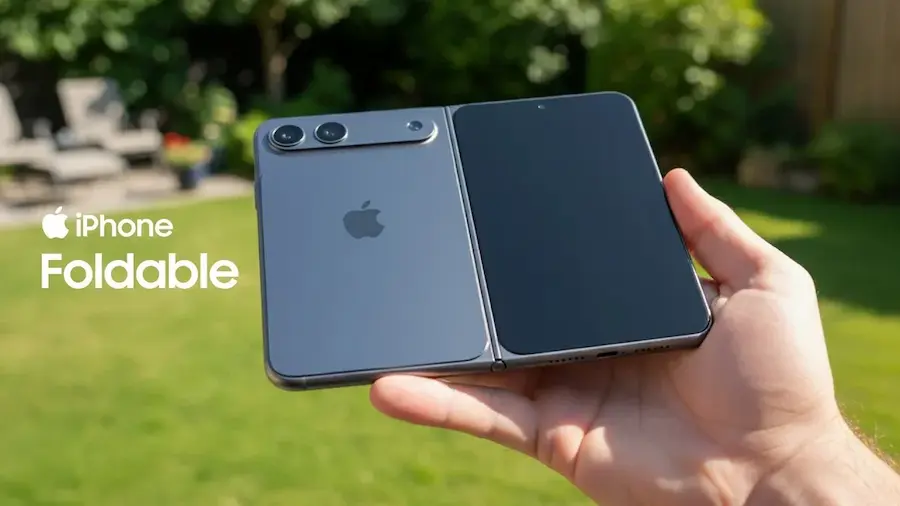

If you’ve been tracking the rumors around Apple’s first foldable iPhone, this week brought several fairly concrete clues about where things are headed. The overall idea remains the same: Apple is reportedly lining up the iPhone Fold for September, and the focus is no longer just on “whether it will launch,” but on how it will tackle the areas where foldables typically stumble—from the screen crease to how the operating system behaves when you open it up.
Among the most notable points, two decisions help frame the product. First, Apple reportedly won’t eliminate the fold line entirely, but it would reduce it. Second, the device would run iOS (not iPadOS) even with an inner panel that’s close in size to an iPad mini, which shapes the kind of multitasking you’ll get and the app ecosystem experience. And yes, there’s also talk of memory, storage, and a camera strategy that seems more conservative than some expected. Is it a “very Apple” move? Pretty much.
The foldable display: less of a crease, but no magic
For months, one of the most repeated promises around the iPhone Fold was that Apple had “solved” the classic problem of the visible crease—that groove many foldables carry down the middle like an unavoidable signature of the form factor. Early reports even described Samsung’s new panel as virtually crease-free, and some went as far as claiming there would be no crease at all.
The key update here is the nuance: according to Mark Gurman (Bloomberg), the display tech Apple is expected to use reduces the crease mark, but doesn’t remove it. In his words, the result wouldn’t be “perfect,” so it’s worth adjusting expectations and assuming the iPhone Fold won’t rewrite the laws of foldable OLED physics—at least not in this first generation. For anyone who has tried a recent foldable, this sounds more realistic: the battle isn’t about hiding the crease 100%, but about making it less noticeable in everyday use, especially when scrolling or watching content with light backgrounds.
As for sizes, leaks point to a 5.5-inch outer display and a 7.8-inch inner display, with an internal 4:3 aspect ratio reminiscent of an iPad mini. That detail matters, because aspect ratio shapes the interface and how apps use the space when the phone is unfolded.
Cameras: hole-punch on both screens and side Touch ID
If you were hoping the iPhone Fold would finally usher in a truly “all-screen” iPhone, it may be time to dial back the hype. At one point, it was said Apple planned to integrate an under-display camera on the inner screen—a notable shift, not so much because the concept is new (it’s already on the market) but because of the image-quality bar Apple typically sets for the front camera.
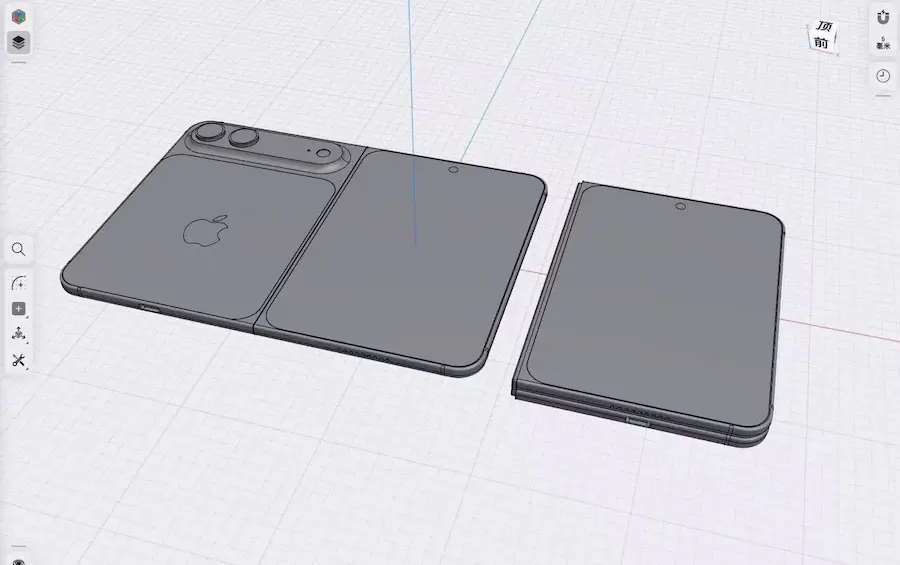
According to Gurman’s latest information, Apple would have dropped the under-display camera because image quality was worse, opting instead for a more straightforward solution: a hole-punch cutout on both the 7.8-inch inner display and the 5.5-inch outer display. It’s a sensible decision if the priority is maintaining consistent front photo and video quality—especially on a high-priced device where compromises are scrutinized.
On the outer display, another long-rumored design point becomes clearer. The cutout would be a small hole replacing the pill-shaped cutout on current iPhones, though Apple would reportedly keep a Dynamic Island-style interface around it for system alerts and Live Activities. In other words, the physical “window” changes, but the software layer that has become part of the iPhone’s recent identity stays.
There’s also a twist on biometrics: there would be no under-display Face ID components. Instead, the device would feature Touch ID in the side button, a solution that fits a foldable design where the front geometry changes depending on whether it’s open or closed. And, honestly, for some users, Touch ID’s return (even on the side) will feel like a nod to long-time iPhone fans—something you notice more in day-to-day use than in a keynote.
iOS with an “iPad-like” layout, plus memory specs
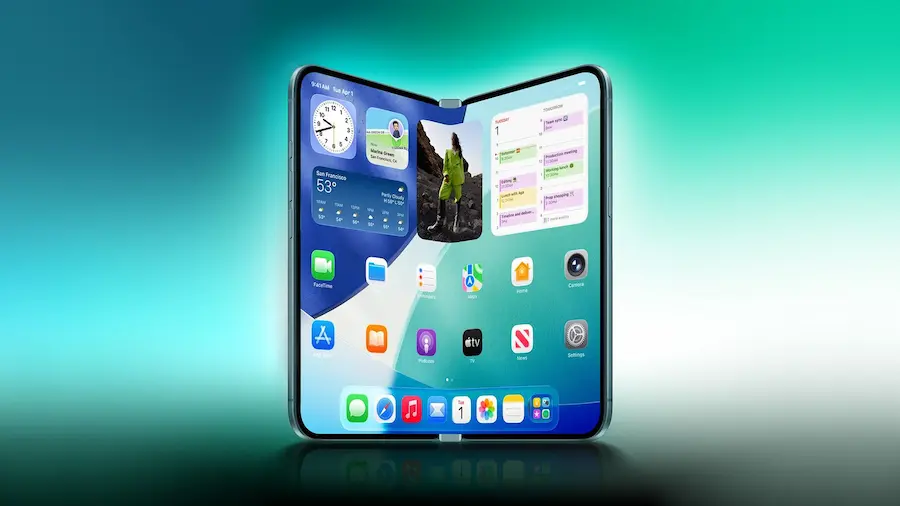
The other major topic is software. With a 7.8-inch inner screen in a 4:3 format, a hybrid approach seemed reasonable: iPhone when closed, iPad when open. The obvious question was: iOS or iPadOS? Gurman is clear: the iPhone Fold will run iOS, though when unfolded it will show an iPad-like layout.
What does that mean in practice? When the device is open, the design is said to allow two-app multitasking side by side, and many apps would adopt left-side sidebars, typical of the iPad experience. Apple would also give developers tools to adapt their existing apps to this new interface. That said, there are clear limits: it wouldn’t support the full range of iPad multitasking, and it wouldn’t run existing iPadOS apps. It’s a bet on keeping the iPhone as the center of the ecosystem and avoiding platform fragmentation—even if that means the “mini tablet” experience won’t be identical to an iPad.
On the hardware side, the first foldable iPhone is said to ship with 12 GB of RAM, in line with other models mentioned in recent rumors such as the iPhone Air and the iPhone 17 Pro/Max. On supply, Samsung is reportedly set to begin DRAM shipments in Q2, aligned with the production schedule, and memory would be more expensive due to global supply pressure driven by the surge in AI servers. For end users, that doesn’t directly change daily use, but it helps explain why a new (and foldable) device isn’t exactly going to land in the “reasonable price” bracket.
Storage details also look fairly defined: the options would be 256 GB, 512 GB, and 1 TB. At the high end, the 1 TB version is suggested to approach $3,000—a figure that, in context, would be close to the cost of two 1 TB iPhone 17 Pro models. That’s not a small detail: the iPhone Fold is shaping up as a premium niche product, more like an engineering (and lineup) showcase than a “new iPhone for everyone.”


