
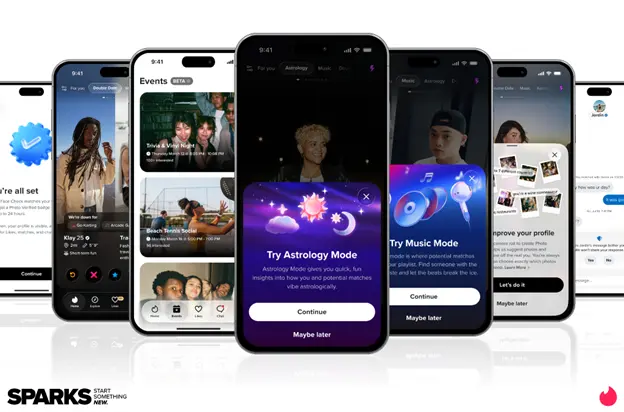

If you were wondering what exactly is changing in Tinder with the arrival of artificial intelligence, the answer isn’t just “we’ll show you profiles you’ll like.” It’s a much broader update: more intentional recommendations, new ways to meet people beyond the usual swipe, and a reinforced safety layer powered by language models to stop toxic messages before they escalate. All of this was unveiled in the Tinder Sparks 2026: Start Something New keynote, where the app made it clear it wants matches to turn back into real conversations—not an endless collection of likes.
The underlying idea is simple, even if the execution is complex: reduce dating-app fatigue, add more context about who’s behind a profile, and at the same time raise the trust bar so people feel comfortable taking the next step. With more than half of its user base under 30, Tinder is pushing toward more authentic, lower-pressure experiences—something that aligns with how many people approach digital relationships today. And yes, AI is the central engine of that shift.
For official details, the full reference is in Tinder’s press release, which lists modes, pilot tests and the gradual rollout of features by country.
AI on Tinder: more intentional recommendations
The biggest AI-related change sits under the Chemistry umbrella: a personalization layer designed to better filter which profiles make sense for you—and when—instead of pushing you into endless scrolling. Rather than relying only on what you swipe right or left, Tinder is proposing a system of curated recommendations backed by richer signals about your personality and preferences, with the goal of cutting down that feeling of “consuming profiles” without getting anywhere.
Within that approach, two pieces help clarify where the product is headed. First, Learning Mode: a real-time recommendation system designed to learn what you’re looking for faster, whether you’ve just created an account or you’re coming back after some time away. According to the company’s internal tests, among new female users this mode is associated with a higher likelihood of returning during the first week—suggesting that early feed tuning can be the difference between sticking around or deleting the app.
Second, there’s Camera Roll Scan, an optional feature that analyzes patterns in your camera roll to generate “Photo Insights” and help reflect your interests, lifestyle and recurring themes. Put another way: if your photos say more about you than your bio does, Tinder wants to extract useful clues so your profile better matches who you are offline. Is it worth granting that access? The key is that it’s opt-in, but it signals the direction: less posing, more real signals.
For rollout context, Tinder said it’s expanding elements of Chemistry beyond Australia and New Zealand into the United States and Canada, with plans to extend it over time and make it a cross-cutting layer across the entire experience—not a standalone feature. This isn’t “AI for show”; it’s a rework of how people are ranked and presented.
New modes and events: from swiping to the real world
Beyond AI, Tinder is expanding formats so connecting doesn’t depend solely on two photos and a clever line. Its Modes system, which previously launched with College Mode and Double Date Mode, is growing in two ways: a redesign of an existing mode and the launch of a new one—both rolling out globally.
Music Mode, active since 2021, is being redesigned to prioritize profiles with shared tastes, with a cleaner interface and a more prominent presence in the app. In early tests, Tinder observed that 1 in 10 users under 22 adopted it after it became more visible. That tracks: music remains one of the fastest ways to move from “hi” to “I’ve had that song on repeat too,” especially when many profiles already use Spotify Anthem.
The big new addition is Astrology Mode, which adds zodiac compatibility by letting you include birth details to show Sun, Moon and Rising signs, along with insights on how that combination might fit with someone else’s. In internal tests, profiles using this mode saw close to a 20% increase in likes sent by women. It’s a telling example of how a “soft” filter—more playful than scientific—can work as an icebreaker; sometimes you don’t need the perfect algorithm, just a reason to start a conversation without sounding like a chatbot.
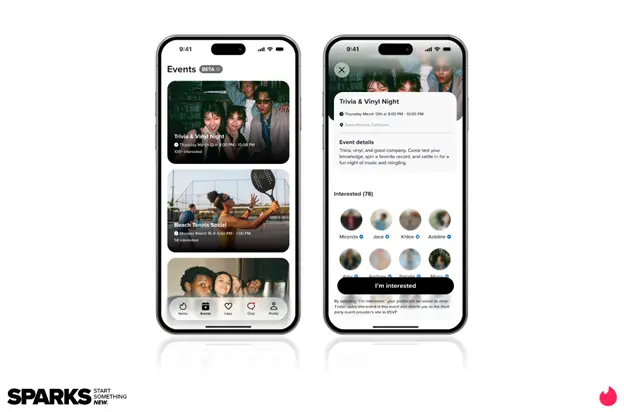
The most ambitious leap is on the hybrid side, with pilots that connect the app to in-person, live experiences. Tinder is starting to test Events as a beta feature in Los Angeles, letting people discover local plans and see which singles are interested in attending, supported by partnerships with organizers. The point isn’t to replace swiping, but to add a discovery layer that can land you at a trivia night or a pottery class with shared context—often worth more than a hundred silent matches.
It also announced video speed dating for later on, with scheduled events and three-minute video chats—with the option to extend—designed for people with photo verification. Done well, it reduces the friction of moving from text to voice or face; done poorly, it turns into an endless waiting room. The requirement to be verified clearly points to the former.
Safety with language models and more authentic profiles
When a dating app positions itself as “more social,” it inevitably has to prove it’s also safer. Here, two tracks come into play: trust infrastructure and a profile redesign that feels more human and less like a “character.” Tinder already has more than 20 global trust-and-safety features, and it’s now strengthening two familiar ones with improvements based on LLMs—models that can understand context and nuance, not just banned words.
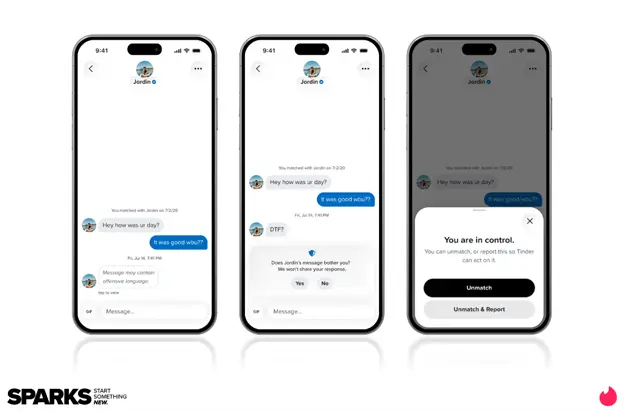
Face Check continues to expand as a mandatory liveness verification to confirm there’s a real person behind the account. And on messaging, Tinder announced upgrades to “Are You Sure?”, the prompt that appears before sending potentially harmful text, and “Does This Bother You?”, which works on the receiving side by detecting inappropriate content and making it easier to report. The key change is moving from keyword detection to a more contextual read of tone, plus a new auto-blur that hides potentially disrespectful messages, giving recipients more control.
In parallel, Tinder is preparing a refresh of the profile experience, with a more immersive design and full-screen photos, including a subtle edge blur effect and a Like/Nope bar with a “liquid glass” look. These UI changes can seem cosmetic, but they’re often tied to something more strategic: if profiles feel more expressive, users decide faster and—hopefully—talk more.
Along those lines comes Tinder Connect, an initiative to bring more real life into profiles through partnerships with apps you already use, starting with Duolingo and Beli, and building on a long-standing partnership with Spotify. The takeaway is clear: if language learning or your food taste says more about you than a random emoji in your bio, it’s better to turn that into raw material for conversations with shared context. And yes, it’s a very 2026 move: less “describe your personality,” more “let your digital habits speak for you,” with the caveat of not turning profiles into a showcase of integrations.
Finally, it previewed tools like Photo Enhance and “Visual Interests” to help people present a more authentic self, along with improvements to onboarding and the profile screen to encourage more complete profiles. There’s a delicate balance here: optimizing presentation without manufacturing an artificially perfect version. After all, if AI helps you find someone compatible but the conversation falls apart due to lack of trust or empty profiles, what’s the match worth?


