


The cyberdeck has become one of those tech oddities that suddenly show up everywhere—on TikTok, in maker forums, and in the corners of the internet where tinkering still matters more than swiping on a screen. If you got here looking for what it is exactly, what it’s for, and how much it costs to put one together, the short answer is pretty straightforward: it’s a homemade portable computer, usually built around a Raspberry Pi, housed in a custom enclosure, and designed as much to be used as to express a very particular idea of technology.
That’s the appeal. It’s not just “a laptop you built yourself,” because a cyberdeck also carries the cyberpunk-inspired aesthetic and philosophy: functional devices assembled from available parts, highly customizable, and far removed from the sealed, closed-off electronics that dominate the market. At a time when almost everything arrives glued shut, synced, and packed with preinstalled features, this kind of creation feels like a delightful anomaly.
What a cyberdeck is and what it can be used for
Practically speaking, a cyberdeck is a customized small portable computer. It’s usually based on a Raspberry Pi, with a battery and a screen added, plus—depending on the project’s approach—a keyboard, mouse, or touch controls. All of that gets integrated into an enclosure made by the user, which can be 3D-printed or repurposed from everyday objects. Yes, it’s the kind of project that feels like it came straight out of Neuromancer, and not by accident: the term “cyberdeck” comes from William Gibson’s 1984 novel.
The reference isn’t just visual. Cyberpunk has always portrayed an ambiguous relationship with technology: highly advanced systems, but also closed, oppressive environments—against which technical creativity becomes a form of resistance. That’s why the cyberdeck fits so naturally with today’s maker culture, where the process of building something personal—imperfect, but functional—matters as much as the end result.
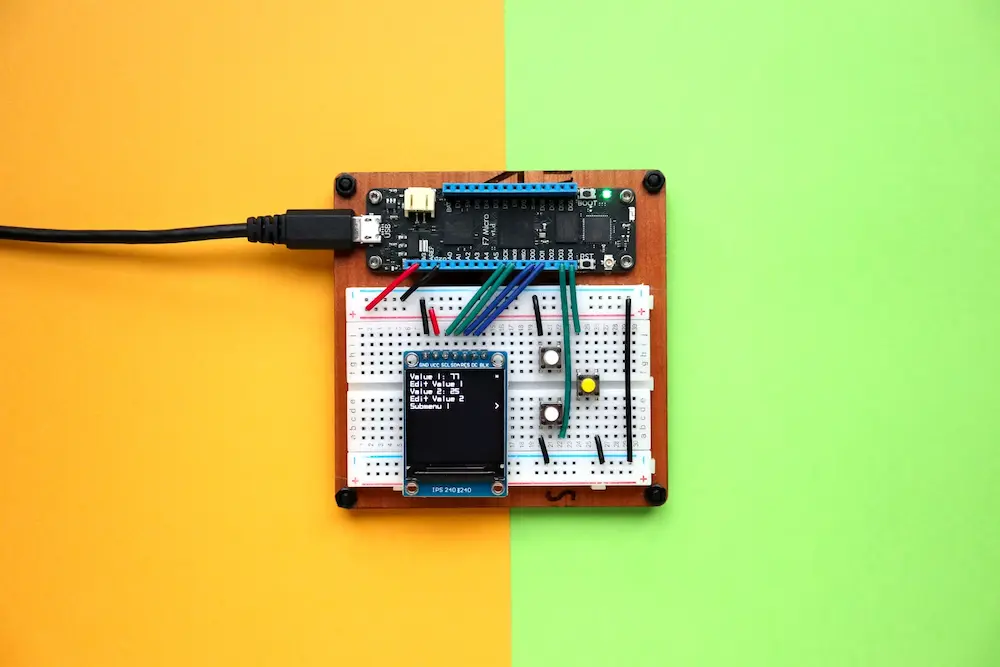
So what can one of these devices do? Essentially, the same things a basic computer can. It can be used for writing, coding, browsing, playing media, or running productivity tools. Some builds are also geared toward emulating old software and games, tasks related to network security assessment, or simply creating a pocket-sized computer with specific utilities. Not all of them are born with a strictly practical mission, of course; some exist because building them is part of the goal—something anyone who’s lost an afternoon fine-tuning a Raspberry Pi will understand all too well.
Basic components, design ideas, and price
The minimum setup for a cyberdeck isn’t complicated, and that accessibility explains a lot of its momentum. The core component is a Raspberry Pi, a compact computer capable of running Linux and handling everyday tasks without too much trouble. From there, you’ll need a screen, a USB power bank, and—if you’re not going with a touch panel—a keyboard and maybe a mouse. The last element is also the most open-ended: the enclosure.
That’s where each project stops resembling the next. Some people design a laptop-style body with a hinge, closer to a traditional computer, while others prefer to fit the system into recycled containers or unexpected accessories. Among the examples cited in the sources are a mermaid-themed clutch purse, an old clamshell-style toy, and even a metal candy tin. It’s not just visual eccentricity; that freedom of form is part of the appeal. A cyberdeck isn’t trying to compete with a Dell or an iMac in polished convenience—it’s offering something those machines rarely allow: real room to intervene, modify, and truly make the object your own.
As for cost, the base can be surprisingly manageable. The sources place the main components between $35 and $135. The cheapest route starts with a Raspberry Pi Zero W for around $15, a basic battery for about $20, and a small screen for another $15. However, the moment you aim for a more usable experience—especially with a 7-inch screen—the budget climbs toward the upper end. And that’s before factoring in the enclosure, keyboard, or peripherals, where the spend can stay at zero if you reuse parts you already have at home, or jump significantly if the project turns into a small portable-lab fantasy.
Why cyberdecks have become trendy
The recent popularity of cyberdecks isn’t explained solely by their striking look, although that blend of handmade gadget and console from a decaying future is undeniably compelling. More interesting is how well they fit into a broader trend: the search for tech experiences that are more hands-on, less automatic, and in a way, slower. The sources link it to a “return to analog,” understood as a reaction to digital overstimulation and smartphone dependency.
Building a cyberdeck means spending time assembling, testing, tweaking, and living with very specific limitations. Compared with a commercial device that does everything and decides almost everything for you, here every part has a reason to exist. For many users, that also becomes a form of digital disconnection—paradoxically achieved through technology. Isn’t it curious that, surrounded by ever more powerful computers, the fascination comes back precisely when you have to assemble one from scratch?
There’s also the chance to escape closed products and preconfigured software. According to the sources, part of today’s interest is a reaction to the growing influence of artificial intelligence and big platforms in consumer hardware. A cyberdeck, by contrast, is presented as a device defined by the user from start to finish: what hardware it uses, what software it runs, and even what shape it takes. It may be small, but it neatly captures a very contemporary idea: taking back control of technology—even if it’s with screws, a power bank, and an unlikely enclosure that looks like it was designed in some garage in cyberspace.


