


Microsoft has made a move in one of the most sensitive areas of artificial intelligence: cybersecurity applied to real-world code. The company has introduced MAI-Cyber-1-Flash, its first cyber model, integrated into MDASH, a multi-agent platform designed to identify, validate and fix software vulnerabilities. The promise is not just about power, but also efficiency: top-tier performance at 50% lower cost compared with its current best configuration in MDASH.
The announcement speaks directly to a problem any security team will recognise immediately: attackers are using AI too, the amount of code that needs reviewing keeps growing, and the old cycle of scanning occasionally and patching later is starting to feel as comfortable as it is dangerous. What good is finding a breach if the process to close it arrives too late? That is where Microsoft wants to position this system, with an AI capable of working continuously across complex codebases.
A compact model for security that never sleeps
The key to MAI-Cyber-1-Flash is that it is not trying to be the biggest model in the room at all times, but the most suitable one for most tasks. Microsoft describes it as a compact model, highly focused on code and security, derived from the MAI-Thinking-1 line and trained internally with high-quality data. Its role within MDASH is to handle up to 90% of routine work, reserving larger and more expensive models, such as GPT-5.4, for the 10% of especially difficult cases.
That distribution of workloads is more interesting than it may seem. In cybersecurity, cost per token stops being a technical detail and becomes an operational constraint when threats need to be analysed constantly. According to Microsoft, the combination of MDASH and MAI-Cyber-1-Flash reaches 96% in CyberGym, a benchmark focused on reasoning over large codebases to detect real vulnerabilities, and outperforms Mythos by 12 points. It is also said to rank ahead of Gemini and GPT in that evaluation.
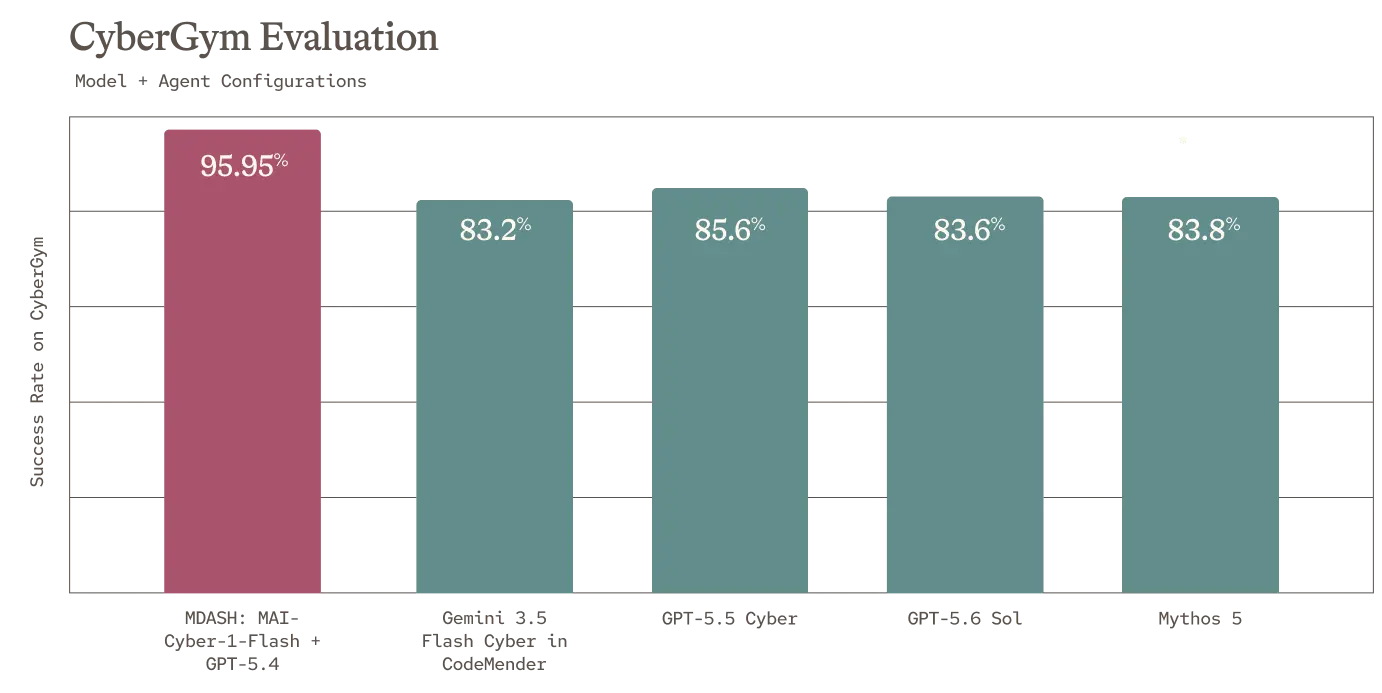
The practical takeaway is fairly clear: this is not about throwing the heaviest model at everything, like using a hammer for every screw, but about orchestrating several models according to the difficulty of each task. Very much in the Copilot era, but with less demo gloss and more of the feel of a SOC working in shifts.
MDASH, Perception and the value of historical data
MAI-Cyber-1-Flash is not arriving as a standalone piece. Microsoft is integrating it into MDASH, its multi-agent system for vulnerability identification and remediation, tuned by security specialists and built with more than 100 agents using different leading models. The role of these agents is to find flaws, verify them and help remediate them, a chain that modern teams can no longer leave solely to occasional manual reviews.
The company summarises its approach around three pillars: model, data and orchestration environment. The model provides specialised reasoning over code; the data comes from decades of building security systems and from daily signals across identity, endpoint, cloud and network; and the harness, MDASH, organises the agents’ work so the analysis does not end up as a neat-looking alert that nobody actually closes. Microsoft mentions more than 100 trillion security signals per day and the operational experience of 1.6 million customers, a scale that is difficult to replicate outside the major cloud providers.
Alongside this comes Perception, a new agentic security system that provides teams of agents for different workflows within MDASH. Its goal is to monitor, patch and close threat vectors continuously, and Microsoft says it will also use MAI-Cyber-1-Flash for more security tasks beyond software vulnerabilities.
Security by design and a learning loop
The other sensitive point in the announcement is trust. A model capable of finding vulnerabilities also needs limits, controls and a carefully managed deployment, because nobody wants a defensive tool to end up looking too much like a Swiss Army knife in the wrong hands. Microsoft says MAI-Cyber-1-Flash has been developed with security-focused calibration, evaluations by the company’s AI Red Team, automated and expert-led adversarial testing, as well as an independent third-party assessment.
The enterprise layer comes through MDASH, with role-based controls, tenant isolation, encryption, auditing and isolated execution environments with no internet access. These details are less spectacular than a benchmark score, but in corporate environments they matter far more than any chart with coloured bars. The promise is to offer strong capabilities for defenders without giving up governance, control and traceability.
Microsoft also frames cybersecurity as a continuous learning loop. Every investigation, alert, containment action, block or patch provides signals about what worked and what did not. By connecting vulnerabilities, attacks, defences and outcomes, the company wants to feed models that improve over time and act as increasingly expert defenders. The approach fits the new reality: if AI accelerates attackers, defence needs more than scheduled patching.


