
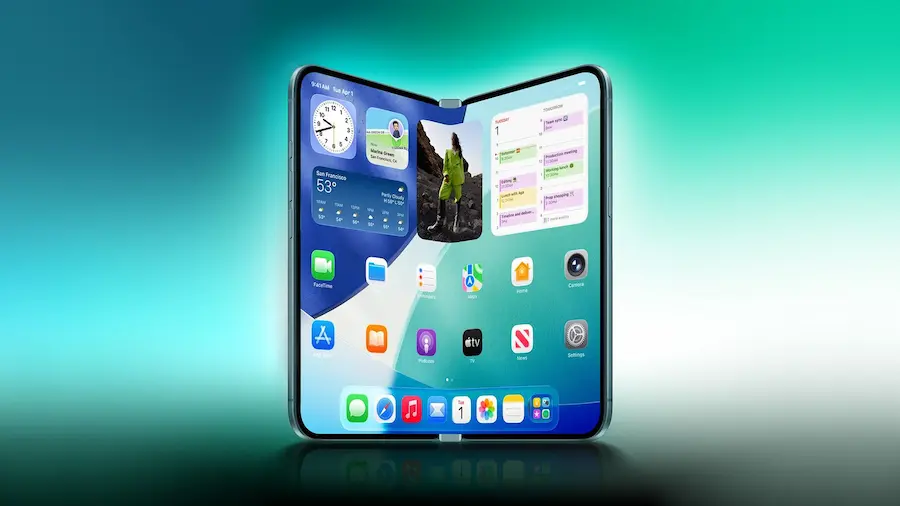

If you’ve been waiting for Apple to properly enter the foldable space, the latest information making the rounds is starting to paint a fairly specific picture for 2026: a fall launch featuring only three “premium” iPhones (iPhone 18 Pro, iPhone 18 Pro Max and the long-rumored iPhone Fold), while the more “base” models would be pushed to spring. The details come from an investor note by analyst Jeff Pu which, beyond discussing market trends, includes a spec table covering display, processor, memory, cameras, materials and biometrics.
The search intent here is straightforward: what’s known about Apple’s foldable iPhone, how it fits into the iPhone 18 lineup, and which technical choices could end up being decisive. On that front, the most eye-catching point is biometrics: the iPhone Fold would reportedly drop Face ID and stick with Touch ID, while the iPhone 18 Pro models would keep Face ID with a smaller “Dynamic Island.” Touch ID returning to a high-end iPhone in 2026? It sounds almost retro, but it makes sense if a foldable design complicates the face-recognition hardware.
A fall lineup with three “Pro” iPhones and a foldable
According to the note, Apple would launch only three models in September 2026: iPhone 18 Pro, iPhone 18 Pro Max and iPhone Fold. In parallel, it mentions that the “base” iPhone 18 would arrive in spring, alongside iPhone 18e and iPhone Air 2, which fits with the (still unconfirmed) possibility of a more spread-out release calendar across the year. This strategy also helps clearly separate the most advanced models from the more accessible ones—something that, from a marketing and supply-chain perspective, can create more room to balance production and demand.
The source itself adds an important caveat: Jeff Pu is sometimes right, but he also tends to bring timelines forward or treat elements as settled that later don’t materialize. Still, the spec table isn’t particularly outlandish; it’s fairly conservative on the Pro side, which makes it feel consistent with a rumor trying to stay on the cautious end.
As for displays, the iPhone 18 Pro models would land at 6.3 inches (Pro) and 6.9 inches (Pro Max). The iPhone Fold, meanwhile, would go for a book-style format: 7.8 inches on the internal display when unfolded, and 5.3 inches on the outer display. There’s no mention of resolution, refresh rate or panel technology, so anything beyond size would be speculation.
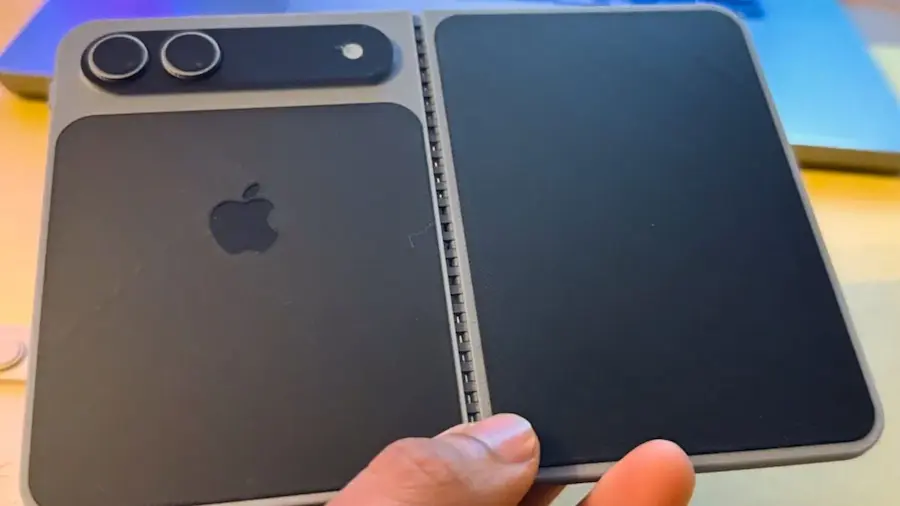
One construction detail also stands out: while the Pro models would use an aluminum frame, the foldable would combine titanium and aluminum. It’s an interesting mix—possibly aimed at balancing structural strength and weight in a device that, by definition, deals with more mechanical stress than a conventional phone (yes, that hinge changes everything, even if there’s no data about it here).
Touch ID on the iPhone Fold and a subtler Face ID
Biometrics is the point generating the biggest headlines. Pu reiterates that the iPhone Fold would not include Face ID and would opt for Touch ID instead. By contrast, iPhone 18 Pro and iPhone 18 Pro Max would feature Face ID using structured light, and with a smaller Dynamic Island. That suggests Apple would continue refining the front sensor and camera integration without necessarily jumping to a completely “clean” display.
The foldable sticking with Touch ID can be read as a practical decision. In a design that switches between folded and unfolded use, with two possible usage positions and two front-facing cameras (according to this table), a full facial-recognition system could become complicated due to alignment, internal space, or the thickness of the module itself. Touch ID, on the other hand, can be handled with a sensor integrated into a button or a specific area of the chassis. The table doesn’t specify where the reader would be, so it’s best to keep it at the general takeaway: Touch ID is the chosen solution, with no Face ID.
There’s also mention of front cameras: on the Pro models, it lists an 18 MP sensor with 6P lens. On the iPhone Fold, two 18 MP entries appear—one for use when folded and another for use when unfolded. There are no details on aperture or stabilization, so this is more useful for understanding the device’s architecture (two front-camera modes) than for predicting real-world image quality.
On the rear, the iPhone 18 Pro and Pro Max would have a setup that includes a 48 MP sensor with 7P VA lens, a 48 MP periscope telephoto, and another 48 MP camera with 6P lens. For the iPhone Fold, the table lists two cameras: 48 MP with 7P lens and 48 MP with 6P lens, with no reference to a periscope module. That’s a meaningful nuance, as it suggests the foldable might prioritize internal design and thickness over a more complex zoom module—though there’s no explicit explanation here, just its absence in the table.
A20 Pro, 12 GB of RAM, and a focus on on-device AI
Across the three leaked models, the core chip would be the A20 Pro, built on N2 with WMCM packaging, paired with 12 GB of LPDDR5 memory. Matching RAM across the entire fall “premium” lineup makes sense if the goal is consistency for demanding features, especially local workloads. In fact, the report ties this hardware baseline to Apple’s AI roadmap, with the aim of boosting on-device AI workloads.

The analyst explicitly says these upgrades are aimed at more advanced AI processing, including a more capable Siri that Apple expects to roll out in 2026. He doesn’t go into specific features, but the message is clear: more performance and more memory to do more without relying as heavily on the cloud—right at the center of today’s debate around privacy, latency and compute cost (and yes, it’s the kind of race everyone wants in on, from Android phones to laptops with NPUs).
Another shared element is the modem: all three fall iPhones would use “Apple C2.” The note doesn’t spell out improvements, supported standards or network generations, but the fact that it’s called out as a key component reinforces the idea of a shared connectivity platform between the Pro models and the foldable.
Finally, the note frames the launch within a market that, according to Pu, could see a 4% decline in global shipments in 2026, mainly due to higher memory costs and softer demand in entry-level and mid-range Android. In that scenario, the analyst estimates Apple would grow 2% year over year to 250 million iPhones, raising market share to 21% (up from 20% in 2025 and 19% in 2024). He also points to “resilient” iPhone 17 demand, with an upward adjustment to manufacturing expectations for fiscal Q1 2026. In other words: Apple would head into 2026 with momentum and a clear high-end push… and, at last, a foldable that stops being a recurring meme in the rumor mill.


