
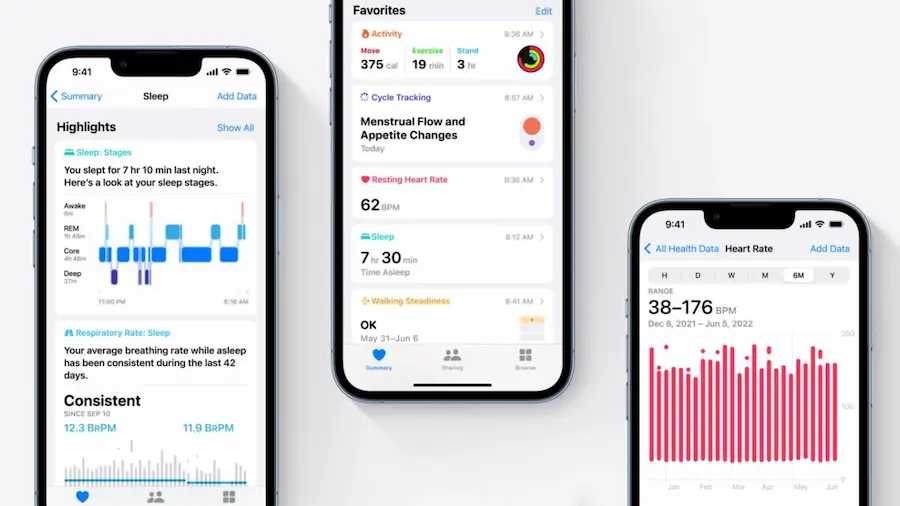

If you’ve been following the rumors about a potential Apple Health+ powered by Apple Intelligence, it may be time to recalibrate expectations: according to a report cited by Bloomberg, Apple would be scaling back the scope of that initiative and, rather than launching a big branded “bundle” with a subscription, it would lean toward shipping health features in smaller, faster releases.
The shift would come down to internal changes. After Jeff Williams stepped back, Services chief Eddy Cue reportedly moved to lead Apple Health and restructure the plans. And while Apple has never officially announced Health+ or confirmed any of this, the move fits a pattern we’ve seen from Cupertino before: when a category is sensitive (and health definitely is), the pace and the release format matter as much as the technology behind it.
The most important takeaway for anyone tracking the story is simple: Apple doesn’t appear to be abandoning the work it’s done, but rather rolling it out more carefully—reducing friction and likely avoiding the “all or nothing” approach that often complicates adoption and messaging. Isn’t it more reasonable for health features to arrive gradually, instead of showing up as a brand-new service that demands immediate trust?
What leaked about Health+ and its AI approach
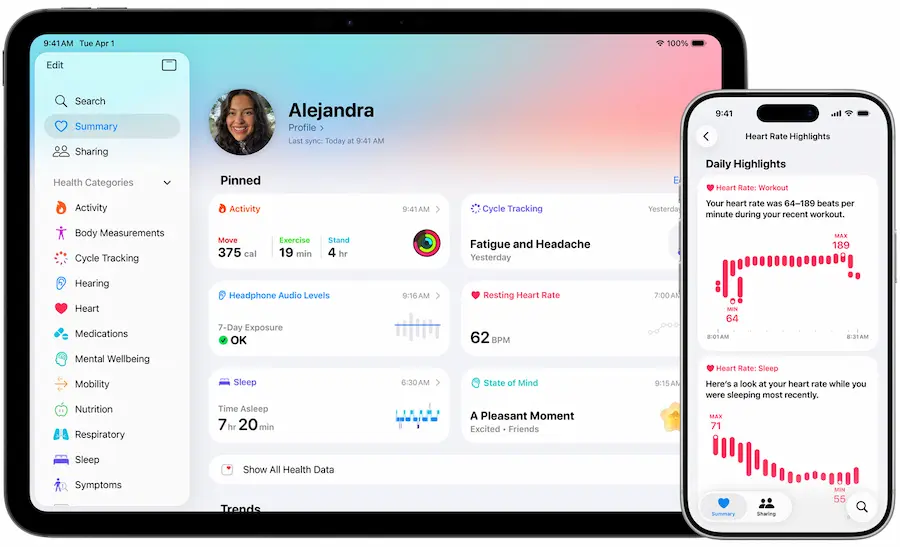
The leaks around Health+ sketched a fairly specific concept: a kind of conversational interface to interact with your health data, paired with professionally produced videos explaining specific topics—like a system-led guide. Users could review trends or logs inside the Health app and then receive guidance and educational content, supposedly tied to surveys and assessments.
In fact, the report says Apple has been recording videos for years at a studio in Oakland, California, to build that content layer. As described, it reads like a natural evolution of the Health app: moving from being a metrics repository to offering recommendations inside the app itself—something that hasn’t been the primary focus so far.
It also mentions Apple tested a chatbot with Health+-style features, but with an important caveat: the company hasn’t made any public announcements, so it’s impossible to know whether that format was the final destination or simply an experimental phase. In health, an impressive prototype isn’t always a shippable product—and if you’ve ever seen demos that never reach users, this will sound familiar.
Another relevant detail is that, according to the report, Apple once planned a version of Health+ for iOS 26, though it reportedly faced internal delays. With that context, splitting the launch into smaller pieces makes sense: when the underlying tech and content already exist, the hard part is often the landing.
The strategy shift: less of a “big debut,” more incremental releases
The core of the rethink, still according to Bloomberg, is that Apple would prefer to break up the set of features planned for Health+ and ship them as gradual updates rather than bundling everything into a new service and potentially a new subscription. In practice, that would mean users could see health-related capabilities arrive in stages instead of waiting for a single “Health+ moment.”
This approach lowers risk on multiple fronts. For one, it makes it easier for users to understand what’s changing and why, without having to buy into a brand-new product with broad promises all at once. It also enables iteration: once one piece is ready, it ships, adoption can be measured, and the next step can be adjusted. For services where the human factor is decisive—and where trust carries extra weight—incremental releases tend to be less flashy, but more resilient.
The original article also notes that comments framing these changes as “failure” or “incompetence” reflect an interpretive angle from the author or anonymous sources, and should be read cautiously. It’s an important caveat: from the outside, it’s not possible to verify what’s happening internally or why each decision is made, and leaks often arrive with their own narrative attached.
In parallel, the report ties this move to two recent context points: Apple Intelligence delays and a collaboration with Google. Without adding details beyond what the source states, the implication is that Apple may be choosing a more pragmatic path to get features to market, rather than holding a major release until everything is perfect.
Health, regulation, and competition: why Apple is moving carefully
There’s one part that the report, as referenced, doesn’t explore in depth: how Apple would align these kinds of updates with potential regulatory concerns and the role of bodies like the FDA. While nothing specific is detailed, the very mention underlines the obvious: once a platform starts recommending, interpreting, or guiding on health topics, legal frameworks and approvals can become the real bottleneck.
In that sense, rolling out features in parts could help clear obstacles, because each component would have a narrower scope and could be validated more easily—both in terms of user communication and compliance. It would also make it easier to shape consumer education, which is especially sensitive in health: adding a new log is not the same as suggesting actions based on questionnaires and assessments.
On the org chart side, the report says Sumbul Desai remains in charge of health initiatives and has also reportedly taken over Apple Fitness recently. If that translates into a more cohesive strategy between Health and Fitness, it would make sense within the ecosystem, even if Apple hasn’t said anything officially.
Competition enters the discussion in an interesting way: it acknowledges strong alternatives in the market, but also points out potential privacy shortcomings—an area where Apple has long tried to differentiate. It also cites a particularly striking precedent: Apple Health integration with ChatGPT was reportedly “a disaster.” Put differently, the baseline is already clear—and not exactly high—for anyone trying to combine conversational AI with health data without flawless execution.
For now, this remains in leak territory. Attention is on potential future announcements around Health and Fitness, with the expectation—according to the report—that something could appear around WWDC 2026 or in an update like iOS 26.4. Until Apple speaks, the sensible takeaway is the essential one: the work behind Health+ likely wouldn’t vanish, but its rollout would be more gradual—less of an “event” and more of a steady evolution, which is often how features that millions of people actually use end up maturing.


