

If you’ve landed here trying to figure out what the 67 or “six seven” meme means, the most honest answer is also the most baffling one: it doesn’t have a fixed meaning. And yet it’s become one of those cultural cues you instantly recognize on TikTok, Instagram Reels, or YouTube Shorts—paired with a hand gesture that looks like weighing two things in the air and a slow intonation that sticks in your head like a chorus.
In 2025, the phenomenon leveled up again when Dictionary.com picked it as its “word of the year,” despite acknowledging there isn’t a real, stable definition. That’s the whole point: “67” works like a wink of belonging—a Generation Alpha social password that frustrates some adults while also nudging them to look at how trends are built today when the algorithm decides something “hits.” Can a “word” really be just a shared vibe with no concrete content? 67 is the perfect example.
From a song to a viral code: the origin of “67”
It starts in music: the phrase comes from “Doot Doot (6 7)” by U.S. rapper Skrilla, connected to the drill scene. In the track, “6-7” shows up inside lyrics shaped by hip-hop slang, including the verb “bip/bipped,” which can mean different things depending on context. What mattered for the meme wasn’t so much the line’s role in the song’s narrative, but how easily it could be turned into a reusable audio clip for short edits.
The ambiguity is baked in. Skrilla himself has said he never meant to lock in a single meaning, even if early on it may have carried a negative connotation before evolving into more positive readings—or simply different meanings in different communities. Meanwhile, theories about what “67” refers to in the song have circulated: everything from specific streets (like 67th Street in Philadelphia or Chicago) to linguistic speculation about police codes, but none of it has stuck as the definitive explanation.
What you can trace clearly is the “vehicle” that launched it: basketball edits. The meme spread especially through clips and highlight reels of LaMelo Ball, point guard for the Charlotte Hornets, whose bio detail lined up a little too perfectly with the number: he’s 6 feet 7 inches tall. That turned “six seven” into an almost automatic tag in videos and montages—and once other players started repeating it in interviews or appearances, the snowball was already rolling.
That expansion also brought in Taylen “TK” Kinney, associated with the phrase through repeated use in Overtime Elite content, to the point of earning the nickname “Mr. 6-7.” From there, the jump to other platforms and formats was pure inertia: you see it, you copy it, you repeat it, and suddenly you can’t remember when it started… exactly the kind of dynamic that would make anyone who’s lived through meme culture from forums to TikTok raise an eyebrow.
So what does “six seven” actually mean?
In everyday use, 67 is more of an interjection than a word with a definition. People use it as a catch-all response, a tag-on to finish a sentence, a way to get attention, or a prompt to see who recognizes the reference. A secondary-school teacher and content creator, Philip Lindsay, described it as something students try to slip into almost any situation—from a question about the time to a comment about someone’s height. The goal often isn’t to communicate a specific idea, but to switch on “meme mode” and see who plays along.
In that sense, Dictionary.com summed it up with a brutal line: its most defining feature is that it’s impossible to define. It described it as omnipresent and absurd—almost the logical “period” at the end of being permanently online, consuming frictionless content and chaining self-feeding trends. And even if that sounds critical, it also explains why it works: the meme survives precisely because you don’t have to understand it to use it.
Even LaMelo Ball, asked about the meaning in a TikTok, boiled it down to something as simple as “it’s really nothing, it’s just six seven.” That lack of stable content isn’t a bug—it’s a feature. In fact, there’s a clear social reading: according to parenting expert Becky Kennedy, the value of the phenomenon is the feeling of connection, that powerful sense of “belonging” when you’re young. That’s why “67” can be empty in content, but not in impact.
And when something helps create a group, it travels fast: it’s shown up in other sports, in celebrations, and outside arenas too. People have used it, for example, in jokes about getting 67% on a test, and even in political contexts, with representatives making public references to the trend.
From classrooms to video games: why the meme doesn’t stay online
One sign that a meme has gone fully mainstream is when it stops being “just an internet thing” and starts causing friction in real life. That happened with 67: it spread through schools to the point where some even banned the gesture or the phrase because of the noise and classroom disruption. That generational clash is almost a pattern: once adults notice it and talk about it, part of the appeal evaporates, because what’s “shared secret” today can become “cringe” tomorrow. Lindsay himself pointed to that possibility after Dictionary.com’s recognition, though he also noted that since the numbers are everywhere, it could stick around in the cultural imagination for quite some time.
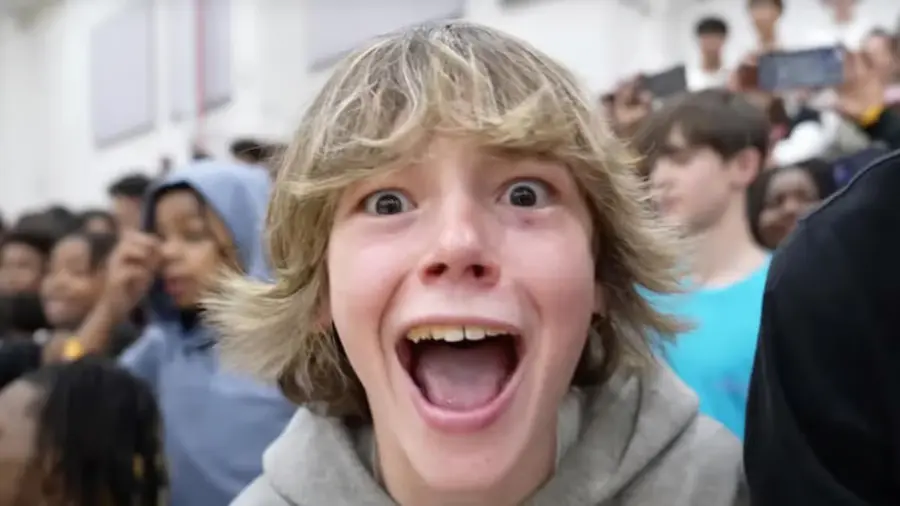
The meme also gained a recognizable “character”: the so-called “67 Kid”, a child, Maverick Trevillian, who went viral after appearing in a YouTube video (posted by Cam Wilder) shouting “six seven” with the signature gesture during a game. Later, in August 2025, weird and grotesque visual edits started circulating—compared to “analog horror”—under the name “SCP-067 Kid,” parodying the collaborative universe of the SCP Foundation (and making it clear it had no connection to the “canonical” SCP-067).
Pop culture didn’t take long to jump on board: the meme inspired music remixes and even made it into an episode of South Park in 2025, using it as a central plot device. And on the more techy side, several video game franchises referenced it through emotes or nods: Clash Royale added one when its Instagram account hit 6.7 million followers, Overwatch 2 announced a “67” emote, and Fortnite Battle Royale even joked about the number while promoting an update before later adding a related gesture. Yes, the meme lifecycle now includes “mental skins” and official content: this is the timeline we’re in.
There were also moves from fast-food brands and chains: promotions tied to 67, and even drastic decisions like removing the number “67” from ordering systems at a restaurant after groups of teenagers showed up en masse. And as a final flourish, Google added an easter egg to searches: when you type “67” or “6-7,” the browser displays an animation that mimics the gesture’s motion—like the meme finally earned a commemorative plaque in the internet museum.
In parallel, some outlets have linked it to the “brain rot” phenomenon—a label used to describe low-quality or repetitive digital content. But reducing it to that alone misses the point: 67 is also an example of how a generation can take a soundbite, strip it of fixed meaning, and turn it into a language of belonging. If you think about it, it’s an emotional dictionary in real time—even if, to adults, it can feel like reading a corrupted file.


